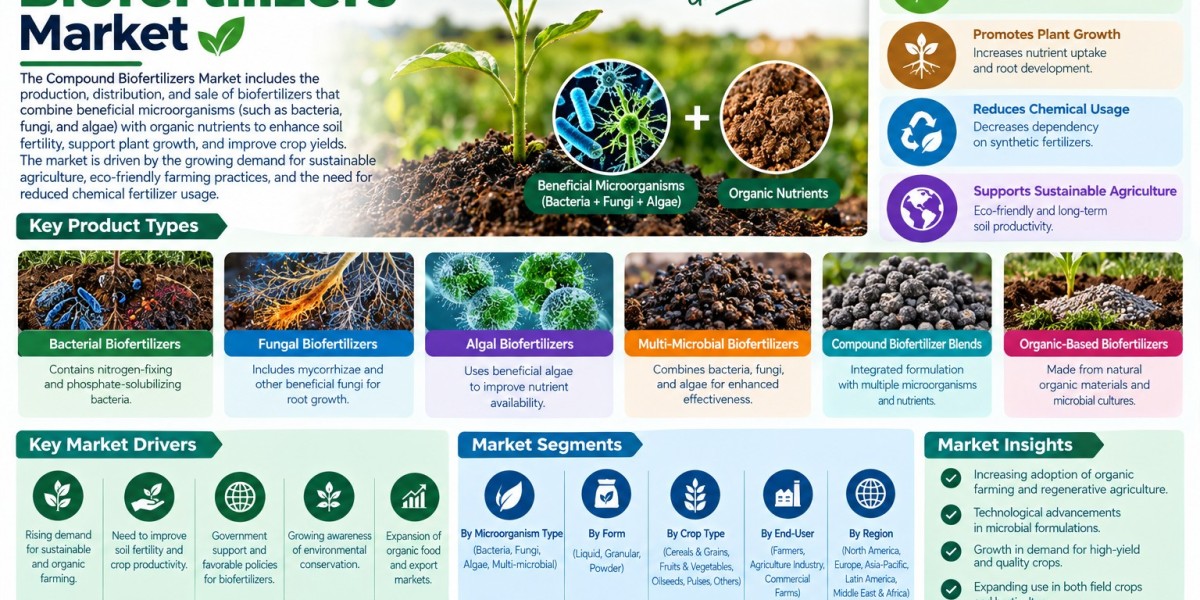

Soil health has become an increasingly important consideration in modern agriculture. Productive cultivation depends not only on supplying nutrients to crops but also on maintaining favorable conditions around plant roots and within the soil environment. Compound biofertilizers are attracting attention because they combine biological fertilizer concepts with broader nutrient-management approaches. Their development reflects a growing interest in agricultural inputs that can support crop cultivation while recognizing the importance of biological activity in soil.
Interest in biological soil amendments is contributing to broader discussions about sustainable agricultural input management. Biological components can interact with soil environments and plant roots, creating opportunities for fertilizer solutions that complement natural soil processes. When these biological elements are combined with customized nutrient formulations, agricultural users can explore approaches designed around specific crop and soil requirements.
The role of microorganisms in agricultural soils is an important part of this discussion. Soil contains diverse microbial communities that participate in natural nutrient cycles and organic matter processes. Certain beneficial microorganisms are used in biofertilizer products because of their relationship with plant nutrition and soil processes. Compound formulations can bring multiple functions together, providing manufacturers with opportunities to develop specialized agricultural inputs.
Customized fertilizer technology can further support this approach. Crop requirements can vary according to plant type, growth stage, soil characteristics, and cultivation environment. Agricultural professionals therefore increasingly consider nutrient management as a process that requires flexibility. Customized fertilizer products can be designed with particular nutrient combinations and biological components to address defined agricultural objectives.
Another important market driver is the broader movement toward sustainable agriculture. Sustainable farming involves multiple practices, including responsible soil management, efficient input use, crop diversification, and attention to environmental conditions. Compound biofertilizers do not represent a single solution to every agricultural challenge, but they can form part of integrated nutrient-management strategies.
Product development remains an important area of opportunity. Manufacturers are exploring formulations that can remain stable during storage, perform effectively under different agricultural conditions, and remain convenient for farmers to apply. The development of microbial combinations and compatible nutrient blends can support the creation of specialized products for different crops and farming environments.
The market also has connections with organic and environmentally conscious agricultural practices. Farmers interested in biological inputs may consider biofertilizers as part of broader soil-management programs. However, product suitability can depend on crop requirements, farming systems, application methods, and local agricultural practices. This makes product information and technical guidance important parts of market development.
Another factor is the growing interest in integrated crop management. Rather than treating fertilizer as an isolated input, growers can consider nutrient management alongside irrigation, soil preparation, crop protection, and cultivation practices. Compound biofertilizers and customized fertilizers can fit within such integrated systems by offering specialized nutrient and biological functions.
Manufacturers can also benefit from expanding product awareness. Farmers need practical information about application methods, storage conditions, compatibility, and appropriate use. Agricultural distributors and technical advisers can help connect product development with actual farming requirements. Effective communication can encourage users to understand the differences between conventional fertilizer products, biological inputs, and customized formulations.
The market's development may also be influenced by regional agricultural diversity. Farming systems differ across climates, soil types, crop categories, and cultivation methods. This diversity creates demand for products that can be adapted to particular agricultural conditions. Manufacturers capable of developing flexible product portfolios may be able to address a wider range of cultivation requirements.
Compound biofertilizers and customized fertilizers therefore represent an important area within the evolving agricultural input landscape. Their relevance is closely associated with soil health, biological activity, targeted nutrition, and sustainable farming practices. Continued innovation can help expand the range of formulations available to agricultural users while supporting the broader movement toward more specialized crop management.
FAQs
Q1. Why is soil health important for agriculture?
Soil health influences nutrient availability, root development, biological activity, and the overall growing environment for crops.
Q2. What role can biofertilizers play in crop management?
Biofertilizers can provide beneficial biological components that interact with soil and plant-root environments as part of a broader crop nutrition strategy.