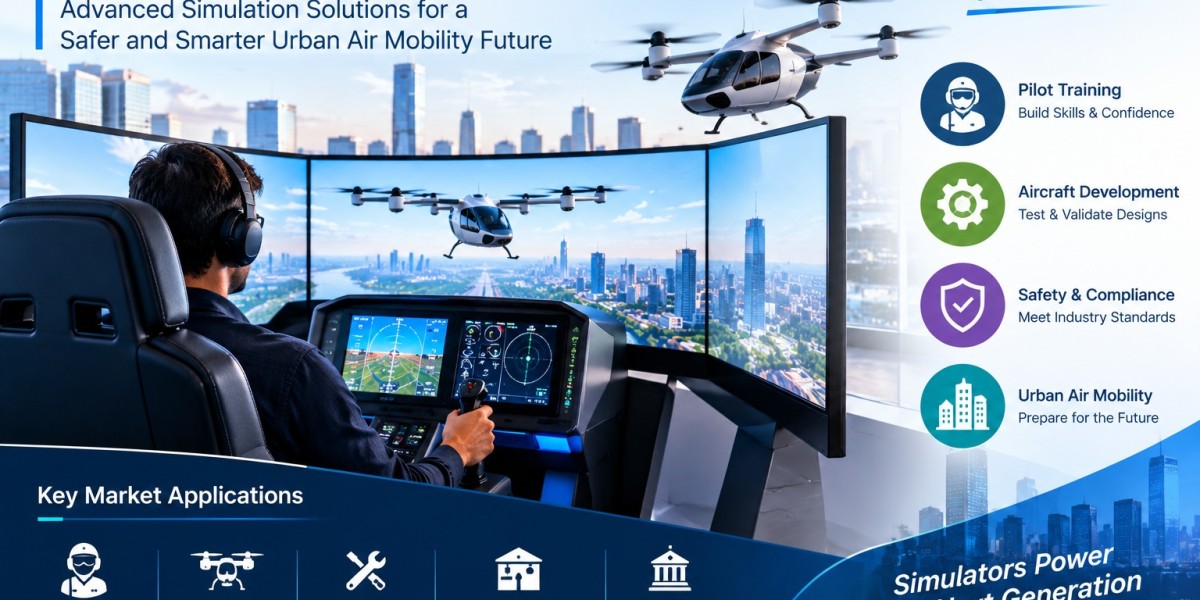

The eVTOL Simulator Market is closely linked to the development of urban air mobility systems. Electric vertical takeoff and landing aircraft are being explored for aviation concepts that could connect locations within and around urban areas. As these aircraft require specialized operating procedures and new approaches to pilot preparation, simulation can help aviation stakeholders understand how these systems may function in different environments.
The emergence of urban air mobility simulation solutions is creating new opportunities for simulator developers, training organizations, aircraft manufacturers, and research institutions. urban air mobility simulation solutions Simulation can recreate urban landscapes, flight routes, landing facilities, environmental conditions, and aircraft operations. This makes it possible to explore different scenarios before conducting corresponding physical activities.
Urban air mobility can involve operating aircraft in environments that are more complex than traditional aviation training areas. Buildings, infrastructure, restricted zones, landing locations, other aircraft, and changing environmental conditions may all influence flight operations. Simulation can reproduce these elements within a digital environment and help users understand how different factors interact.
For pilots, urban simulation can support route familiarization and operational preparation. Trainees can practice approaching and departing from designated landing areas, navigating simulated urban environments, and responding to changing situations. Repetition can help users become more comfortable with procedures before moving into practical aircraft operations.
For manufacturers, simulation can assist with aircraft development. Developers can examine how an eVTOL concept performs in different operational environments and identify areas that may require further testing. Simulated environments can also support the development of control systems and operating procedures.
Urban mobility planning represents another potential application. Researchers and planners can use simulation environments to explore how aircraft might operate between different locations. Virtual scenarios can help teams visualize potential routes, landing areas, traffic interactions, and operating concepts.
The eVTOL Simulator Market also provides opportunities for educational institutions. Universities, aviation schools, and technical training centers can use simulators to introduce students to electric aviation and advanced mobility concepts. Students can learn about aircraft systems, flight controls, navigation, operational planning, and other subjects through interactive simulation.
Virtual reality can further expand access to urban air mobility simulation. Instead of requiring a large physical simulator, VR systems can create digital cockpit environments that allow users to interact with virtual aircraft. This can make certain simulation activities more flexible and accessible.
Augmented reality can provide another layer of interaction. Digital information can be combined with physical equipment or training environments to create mixed learning experiences. Such technologies may become increasingly relevant as training organizations look for ways to combine traditional instruction with digital tools.
The role of simulation also extends to emergency and contingency planning. Urban aviation environments may require pilots and operators to respond to unexpected events. Simulation can provide a safe environment for practicing procedures related to system issues, route changes, weather conditions, and other operational challenges.
As urban air mobility concepts develop, coordination between aircraft, infrastructure, operators, and digital systems will become increasingly important. Simulation can provide a shared environment where different stakeholders can explore these interactions. This can support communication between engineering teams, pilots, researchers, educators, and planners.
Future eVTOL simulators may increasingly incorporate detailed city environments, intelligent traffic scenarios, connected aircraft models, advanced visual systems, and adaptive training features. These capabilities can support a wide range of applications beyond basic flight practice.
The eVTOL Simulator Market therefore has potential opportunities across the broader urban mobility ecosystem. From pilot education to aircraft development and operational planning, simulation can provide a controlled environment for exploring new aviation concepts.
As electric aviation progresses, simulator technology can help stakeholders prepare for new aircraft and new operating models. The ability to test ideas virtually and repeat scenarios can make simulation an important part of the development process for future urban air mobility systems.
FAQs
FAQ 1: Why is simulation important for urban air mobility?
Simulation can recreate complex urban environments and allow pilots, engineers, researchers, and planners to practice or study different operating scenarios.
FAQ 2: Can eVTOL simulators support urban route planning?
Yes. Simulation environments can help users explore potential routes, landing locations, operating conditions, and interactions within an urban aviation environment.