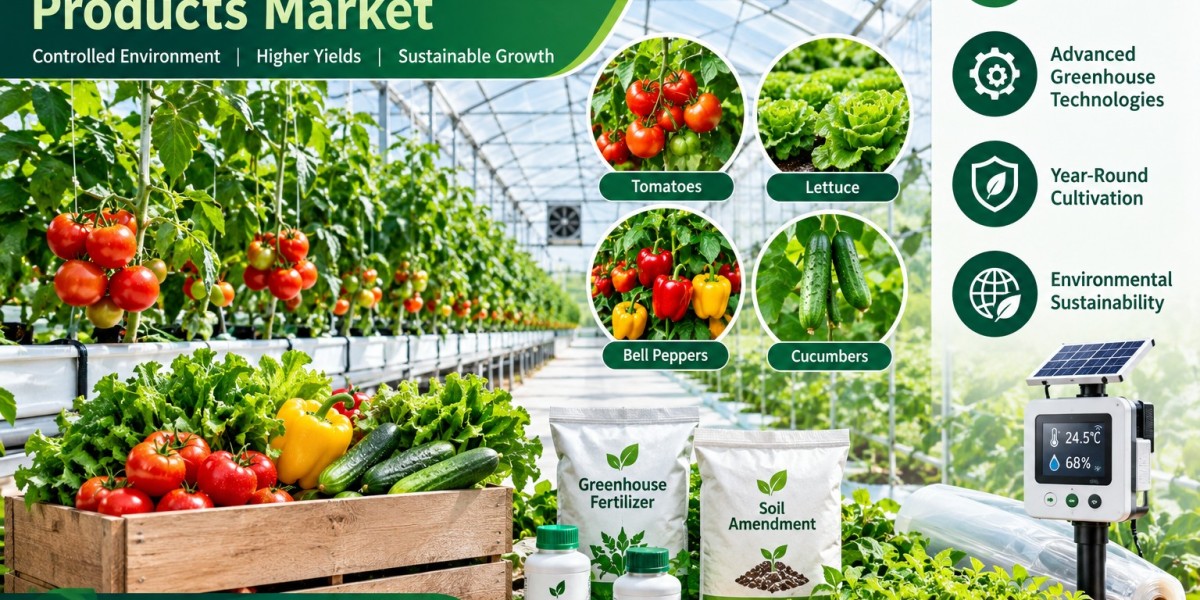

The greenhouse agricultural products market is reshaping the way agricultural businesses approach crop cultivation by combining protected structures with organized crop-management practices. Greenhouses provide an environment where growers can manage conditions surrounding plants more carefully than in conventional open-field cultivation. This makes production greenhouse relevant to a wide range of agricultural products, including vegetables, fruits, herbs, flowers, seedlings, and specialty crops. As farmers seek more adaptable production methods, greenhouse agriculture continues to attract interest as a practical model for modern horticulture.
A key area connected with this market is controlled environment crop production , where growing conditions are managed according to the requirements of selected crops. Instead of treating every crop in the same way, growers can establish cultivation practices based on temperature, moisture, light, ventilation, irrigation, and plant-development needs. This approach allows greenhouse operators to create production strategies that are more closely aligned with the characteristics of individual crops.
The diversity of greenhouse agricultural products provides opportunities for different types of growers. Vegetable producers can use protected structures for crops that require carefully managed growing conditions, while fruit growers can explore varieties suited to greenhouse cultivation. Herbs and leafy greens can also be produced in organized greenhouse environments. Floriculture and ornamental plants provide another area of opportunity, particularly where appearance, consistency, and careful crop handling are important.
Crop planning plays a central role in successful greenhouse production. Growers need to consider the type of crop, growing period, available space, irrigation requirements, environmental conditions, harvesting process, and intended market. Proper planning helps connect cultivation activities with commercial objectives. A greenhouse should therefore be considered not simply as a physical structure but as part of a complete agricultural production system.
The use of technology is increasingly becoming an important part of this system. Sensors and monitoring equipment can help growers observe conditions inside the greenhouse. Automated irrigation can support regular water delivery, while climate-management equipment can assist with ventilation and environmental control. Digital tools can also help organize cultivation activities and provide growers with information that supports daily decision-making.
Another important trend is the growing interest in efficient resource use. Greenhouse farming requires careful management of water, nutrients, energy, growing media, and labor. When these resources are properly organized, growers can create a more consistent production process. Irrigation systems can be designed around crop needs, while cultivation layouts can be planned to use greenhouse space effectively. Resource-conscious farming practices can also contribute to the long-term sustainability of greenhouse operations.
Greenhouse agriculture can additionally support production planning for markets that require consistent agricultural products. Retailers and food-service businesses often need reliable supplies, while consumers may expect fresh and visually appealing produce. Greenhouse operations can coordinate crop cycles, harvesting activities, packaging, and distribution more systematically. This connection between production and market requirements is becoming increasingly important as agricultural supply chains become more organized.
Another area of development is the integration of different cultivation techniques. Depending on the crop and greenhouse design, growers may use soil-based cultivation, soilless systems, hydroponic methods, or other approaches. The choice of growing method depends on crop requirements, infrastructure, operational knowledge, and production goals. This range of options allows greenhouse businesses to develop systems suited to their particular circumstances rather than following one universal model.
Greenhouse farming can also encourage agricultural diversification. Producers who traditionally cultivate a small number of outdoor crops may explore additional horticultural products through protected cultivation. Specialty vegetables, herbs, flowers, seedlings, and other crops can provide opportunities to serve different customer groups. Diversification can also help agricultural businesses develop production strategies around local market preferences and available resources.
Looking ahead, innovation is expected to remain an important part of greenhouse agricultural production. Improvements in monitoring, irrigation, automation, crop management, greenhouse design, and digital agriculture can help growers create more responsive production systems. The emphasis will remain on understanding crop requirements and using appropriate tools to support healthy plant development.
The greenhouse agricultural products market represents a broader shift toward structured and technology-supported farming. By bringing together protected cultivation, crop planning, resource management, monitoring, and market-oriented production, greenhouse agriculture offers growers a flexible framework for producing a wide variety of horticultural products. As agricultural businesses continue to seek adaptable production methods, greenhouse systems can remain an important part of the evolving farming landscape.
FAQs
1. Which products can be cultivated in greenhouses?
Greenhouses can be used for cultivating vegetables, fruits, herbs, leafy greens, flowers, ornamental plants, seedlings, and various specialty horticultural crops, depending on the greenhouse system and crop requirements.
2. How does technology greenhouse support agricultural production?
Technology can assist growers with environmental monitoring, irrigation management, ventilation, crop observation, automation, and production planning. These tools can make greenhouse operations more organized and responsive to crop requirements.